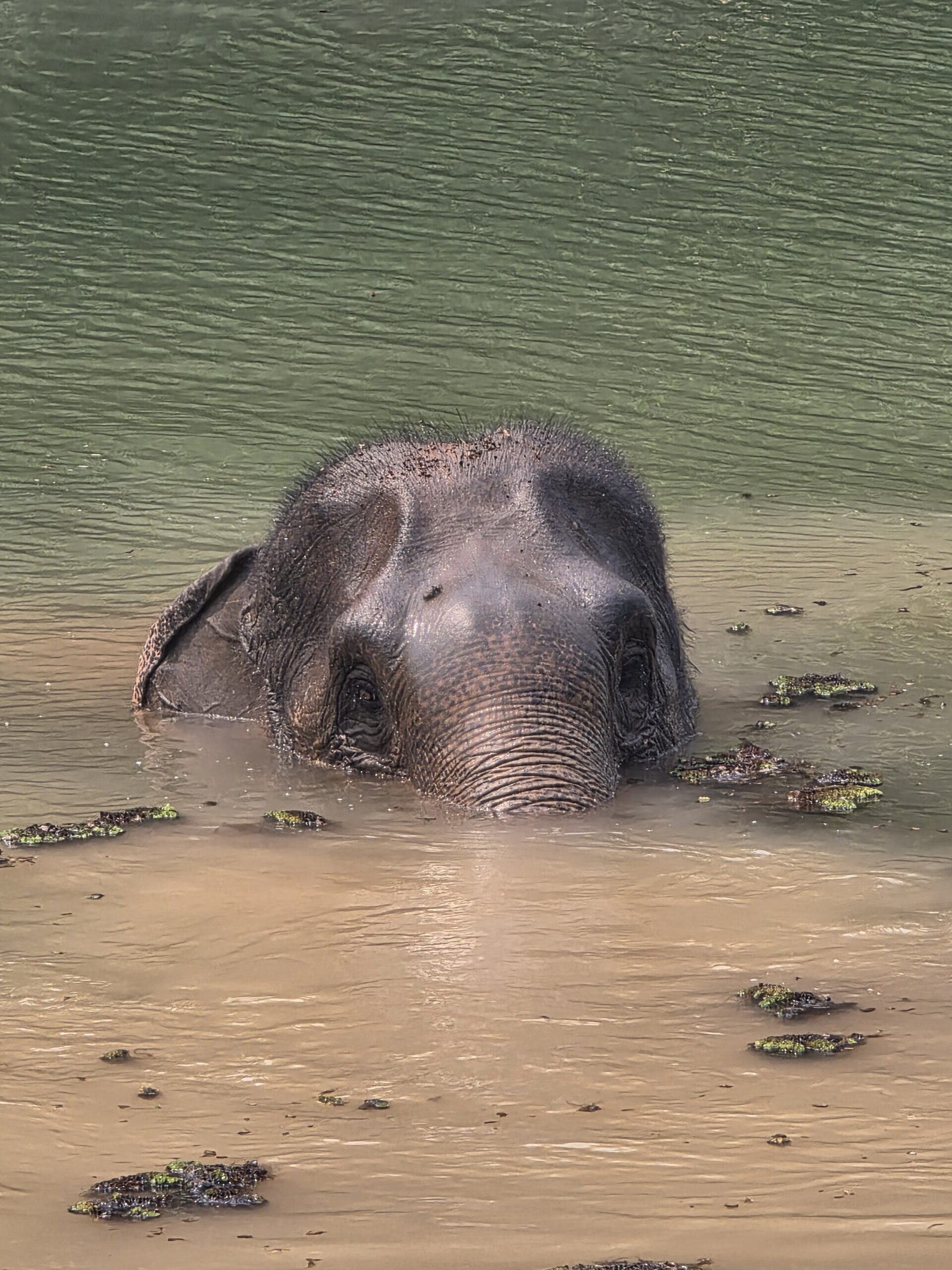
400 elephants are in captivity in Laos, mostly in locations where they are being fed and ridden by tourists. The ECC, the Elephant Conservation Centre, is very different to this. Firstly, you are not allowed to touch them or be within 10 meters of them, and secondly, you are quite sure that this is all about the elephants, not about profit. The two main drivers of the centre are, firstly, to breed the next generation of elephants and secondly, to re-wild the captive elephants in their care. What I hadn’t realised was how difficult these two things could be. Particularly, as Sebastian, the French founder of the centre, described to us, ” they don’t really know how to be elephants”.

The center has a 5R’s mission statement: Rescue, Rehabilitate, Re-herd, Reproduce, Rewind.
What you never think about is that some of these elephants have never seen another elephant before. They may not know how to be sociable or sexual elephants with noone to learn from . One of the lengthier processes on the site is re-herding them. In other words, slowly, slowly introducing them to each other and understanding compatibility and relationships. This is a joint process between the mahout and on-site biologists to determine which friendships are developing and how to improve them. This process in itself can take years and can change over time as a potentially traumatised elephant settles and matures. The actual rewilding of elephants can only occur in groups of 4 or more. The four need to be compatible, able to fend for themselves and defend each other, but also to show personality traits compatible with a wild herd if and when they meet one. The four elephants already re-wilded took seven years to release from human support, and even now, although in a different part of the park that you cannot visit , the Lao Government and ECC share the cost of around-the-clock ranger protection for them from poachers.
Alongside this runs the desire to breed more baby elephants, particularly as birth rates have dropped dramatically recently in the wild population. This is most likely a result of the populations fragmenting across parks so much so that the gene pool is too restrictive. Only one in five pregnancies are resulting in a life birth. This is where rehabilitation comes in at the center. To successfully breed elephants they need to be constantly medically monitored. This is achieved by a positive reinforcement technique where each elephant is walked in to the hospital once each week and ‘bribed’ with bananas to get weight, blood samples, health checks, ultrasound etc. No other center does this, and it may sound invasive, but needed for conservation of the species.

I truly admire the centre’s patience in addressing these issues day by day, year after year. Especially as other threats are also present. One threat is the park’s food supply. An average elephant weighing 3500kg consumes about ten per cent of its body weight in vegetation every day. In my view, the park does appear to be sparse, and they are replanting trees to keep pace with their relentless appetites.
Secondly, their mahouts are ageing and the centre thinks that it may need to start up a training programme to train new ones. 27 elephants require 27 mahouts. Well, I cant believe they can’t recruit. Sign me up!!
Today, we spent the day with one elephant and one mahout. Just magical !


Leave a Reply to Denise 💚 Cancel reply