My new guide, Nom, is an interesting character who is teaching me more about Buddhism and the life of a monk. His story in short. His parents, unable to feed him and his sisters, gave him two options when he was seven years old: work in the rice fields or go to the monastery in Luang Prabang, two hours south of their village, where the Abbot was a family friend. He chose – with ultimately no regrets – to go to the monastery. Despite crippling homesickness and lots of tears at the beginning, he would go on to stay for 13 years. Where he would get all his general schooling as well as Buddhist teachings. His second good fortune was to win one of three scholarships given to Lao students by the Thai Buddhist school to attend university in Thailand, where he would study English and Buddhism. He lived in Thailand for seven years until the death of his father brought him back to Laos to live with and look after his mother. Now working as a tour guide, he seems to have put his life on hold, happily dedicating all his time to his mother. Knowing too that he needs to generate a dowry if he is to get married and have his own family. Suspecting that this will not happen, he thinks he will eventually return to the Monastery, where he said he was at his happiest.

Life as a monk sounded really tough : early mornings, strict regimes of prayers, chanting and schooling , little food and no play. I asked him if he and ‘his mates’ every kicked around a football and he was horrified by the thought. To better understand I said I would like to dip in to my holiday funds and go to give alms.

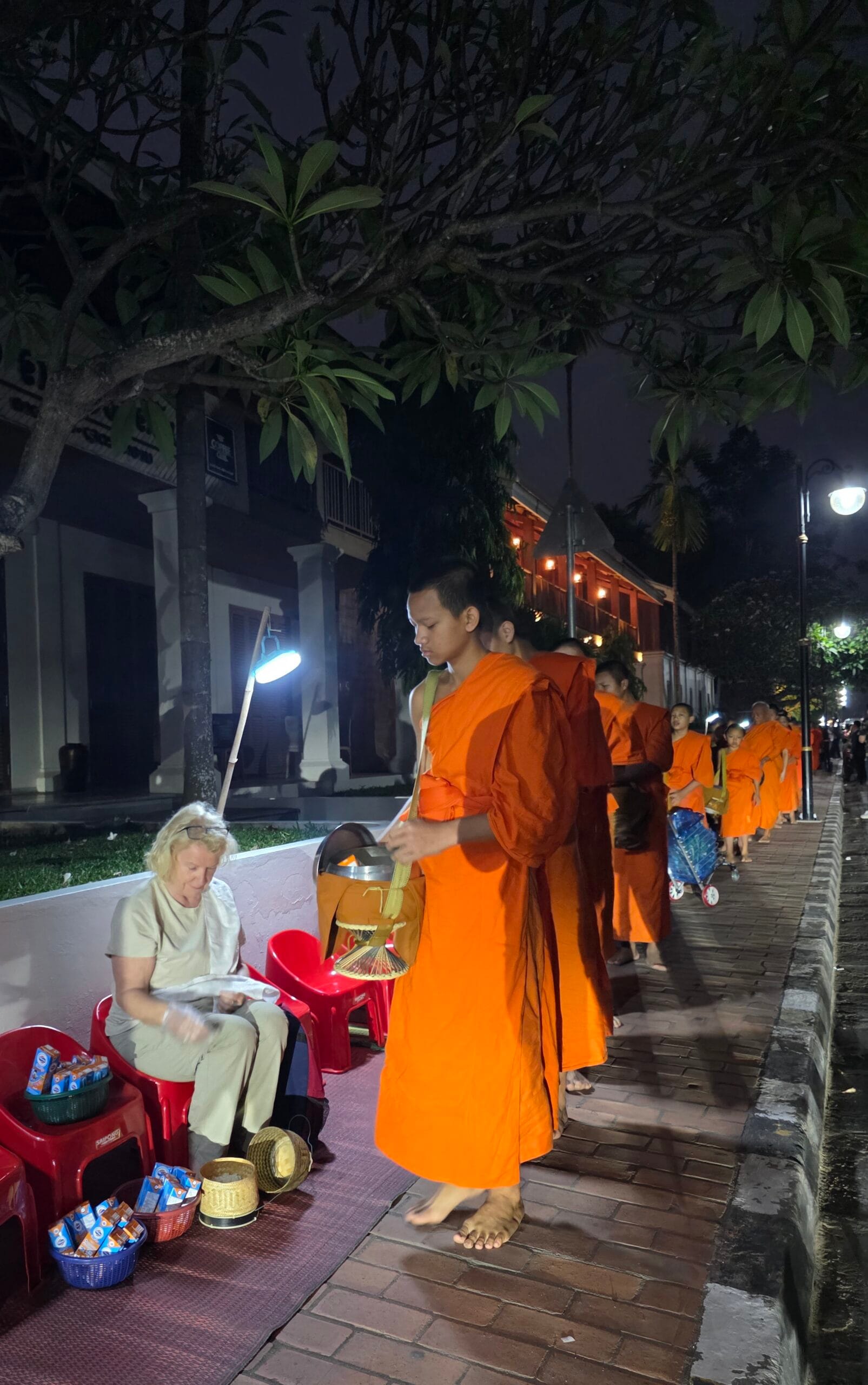
So this was me this morning (main pic), up at 4.45am and down at the temple in Luang Prabang for 5.30am when an orderly line of 50/ 60 monks passed me whilst I put either a small ball of sticky rice or carton of milk in to their raffia containers. Nom instructed me not to look at them, smile and strictly not to speak. The same was true for them, although …shhh…one of the elderly monks said “thank you” to me in good English. It seemed a strange transaction without any feeling. I understand that I am to be selflessly generous, but I can’t understand why they can’t show just a ickle bit of gratitude. Nom said that sticky rice was breakfast and lunch in the monastery and then no further food for the rest of the day, only drinks of water, coffee or milk. Many looked painfully thin to me. That’s when I sneaked a look!
Onwards from here we visited the main temples, Presidential Palace and at my request a silk farm ( have always wanted to see this). Leaving Nom then to get fuel for his motorbike ( there is a serious possibility that the country will soon run out because of the Trump war) I returned to the hotel for a siesta. Before going on to the theatre for a performance that I had no clue about ( but very colourful) and finally braving some street food. Yum!


If you ever get to Laos, Luang Prabang, should definitely be on your list. Lots of culture, beautiful old buildings ( protected because of UNESCO), greenery, interesting markets, coffee shops, the Mekong, restaurants, nice hotels ( even an Aman at 1000 USD per night) and a very relaxed, uncrowded, unhurried feel. Oh, and here, for the first time in a week, I have seen some Europeans. Not many… but just a few.


Scholars now agree that Buddha was born in Nepal but lived and died in India around 400 BCE. Beginning his faith in his mid-40s and passing away in his 80’s. The only question that puzzled Nom was why, then, are there millions of Buddha statues in South East Asia and beyond, depicting him in his 20s?


Leave a Reply to kath hayhurst Cancel reply