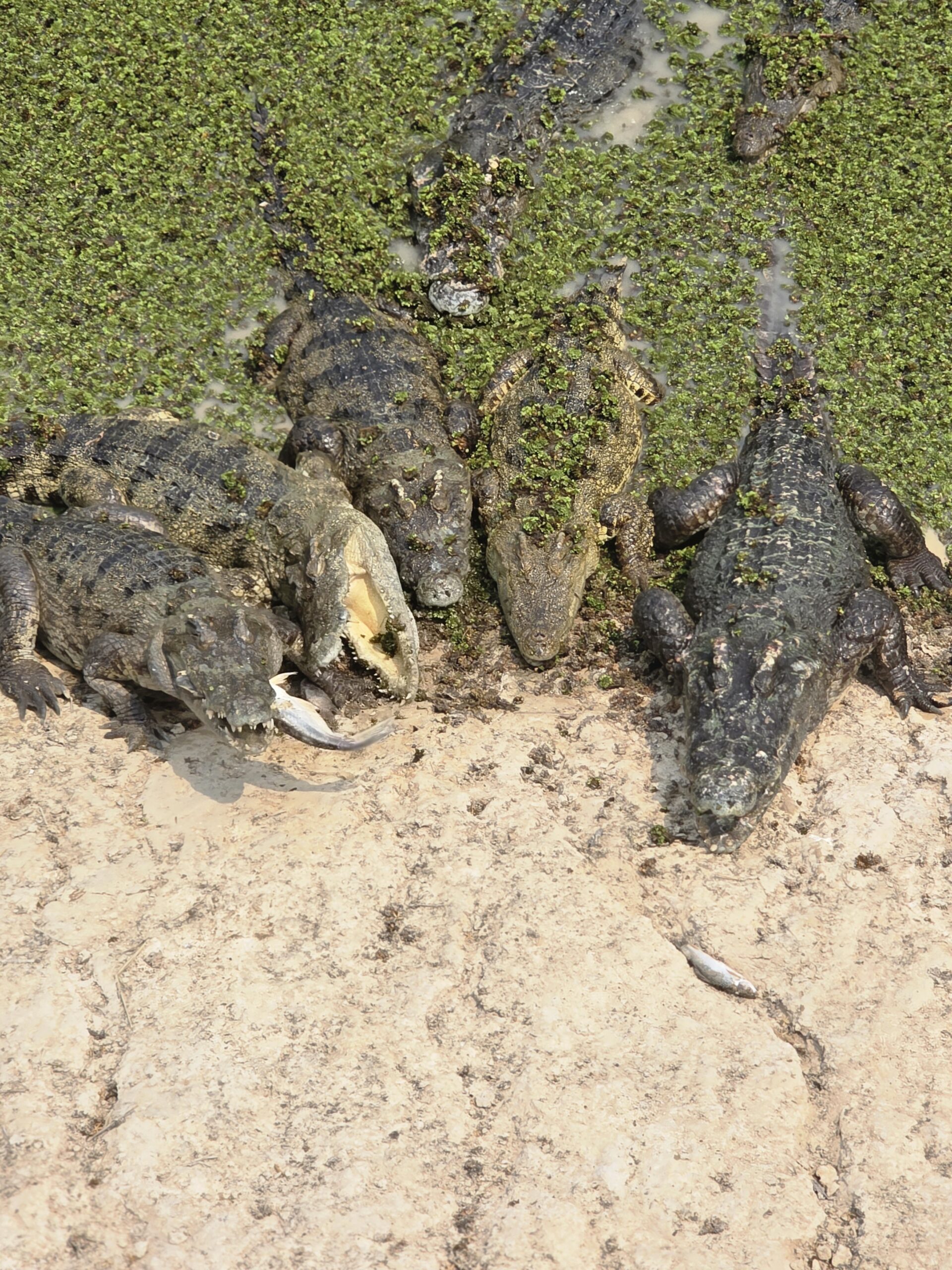
Another madly busy day. Food preparation, then ‘Upstairs’ huff puff, 38 degrees and 45% humidity to feed and muck out the primates. Machete some grass for the newly arrived Muntjac and made 30 lollipops for the bears to fight over tomorrow. But today’s highlight was feeding the 74 adult crocodiles their once-a-week fish dinner. I don’t know exactly how much this was, but my guess is 90 to 100kg. Maybe not as much as I imagined, when in Africa, one wildebeest at the Mara River crossing never seems to be enough.
We were to feed them from two stations thankfully well above a jawline above them. The scent of the fish sent torpedo-like projectiles through the lily-topped, silent water until they were right below us, lined up to feed (main pic). The really big guys at the front, and the smaller, lower-ranking individuals to the back or off to the sides. A little video gives you a flavour. I’m sorry about my ‘big boy’ comment in a deep Brummie accent. I think it was the adrenaline rush of the moment 🙂


These crocs have been at the centre since it was a zoo, and now they have a successful breeding programme with several juveniles in a separate pool, and even some small babies (pic below) whom you can only peep at through a small gap in the fencing. By not exposing them to any human contact, the centre hopes, in conjunction with the Lao Government, to try a reintroduction programme once they can find a location and community willing to accept them. Not easy.

Interestingly, when the crocs were moved to their current location, each was DNA-tested, and, apart from one of the 74 adults, all were found to be Critically Endangered Siamese Crocodiles. The most extinct and least studied crocodile in the world. In 1992, it came very close to being classified as ‘fully extinct’ in the wild when sightings were made in Cambodia with an estimated 200 animals. Much smaller wild populations of only few animals have now also been seen in Thailand, Vietnam and Laos, but they are incredibly incredibly rare in the wild.
The numbers will have depleted for a catalogue of reasons: Human encroachment, Human take over of their ranges, habitats and food sources, Humans converting their wetlands in to agricultural land, Human use of fertilisers, Human use of pesticides on rice crops, Human advent of cattle farming, Human created Vietnam War killing many with ordnance, Human created Hydroelectric dams on the Mekong and tributaries, Human fishing nets and traps, Humans illegally capturing them to put them in to crocodile farms. You get the gist, it’s we humans again. Sorry, big boy.
This is the story of Siamese Crocodiles in the wild. The flip side is that 700,000 captively bred Siamese Crocodiles are held in crocodile farms across Southeast Asia. Farmed for their skins and for meat.
